


Part 1
READING PASSAGE 1
You should spend about 20 minutes on Questions 1-14, which are based on Reading Passage 1 below.
Marketing And Mind Control
How marketing and advertising appeal to the associative nature of the brain
While there had been a long tradition of giving rings as a commitment to marry, the custom of giving diamond engagement rings was in large part manufactured by one of the most effective marketing campaigns in history . In the early 1900s, diamond sales were declining, posing a serious problem for the company that essentially had control over the diamond market. In 1938, this company hired an advertising agency. Which proposed reshaping social attitudes toward diamonds? As well as magazines showing film stars draped in diamonds, the agency arranged for movies to incorporate diamond engagement rings into their plots. The campaign culminated with the slogan:' A diamond is forever. At the time, the approach was unique. Rather than pushing a brand, the objective was to promote diamonds as the symbol of everlasting love. This was achieved by exploiting the associative nature of the brain: associating neurons! Activated by the concept of' love ' with neurons that encoded the concept of “diamonds. By 1941, diamond sales had increased by 55 %.
Advertising comes in many forms, from blatant neon signs to subtly embedded products in movies. In each case, the goal is to mould our habits, desires and opinions. Our visual system is targeted by an avalanche of information on the internet, street posters, and billboards and in movie theatres. Our auditory system submits to catchy radio jingles and telemarketers. More surreptitiously, our olfactory system is targeted by variations of vanilla and citrus perfumes aimed at enticing US to linger in a retail outlet. It is difficult to measure how effective these campaigns are, but as in the ' A diamond is forever ’ campaign, they can be so successful that they change the fabric of our culture. In the case of bottled water, we are swayed by advertising into paying for something that we can obtain for free. Most people cannot distinguish bottled from tap water, much less between brands of bottled water, which is why you rarely hear of a bottled water company proposing a blind taste test.
So why is marketing such an effective mind - control technique? It is interesting to consider whether other animals exhibit anything analogous to humans ' susceptibility to advertising. If we provide a lab rat with two types of cereal, it will consume approximately the same amount of each. However, if we put that rat with another rat that spent its day eating just one type, when faced with a choice, our rat will now show a preference for the same type as the other rat was eating. Psychologists call this ' socially transmitted food preference ‘.
What many regard as the first documented examples of cultural learning in primates started with a clever monkey that lived in a colony of Japanese monkeys on the island of Koshima. She began taking her dirt - covered sweet potatoes to the river to wash them before eating them. Upon seeing this, a few 11 other open - minded monkeys picked up on the idea. Potato washing then spread from monkey to monkey and, over the course of a few years, most monkeys were eating clean potatoes. Humans are clearly not the only animals to engage in imitation and social learning.
Learning by observation can be an extraordinarily valuable brain feature, this is how we learn to communicate and perform motor skills as well as deal with many everyday problems. For example, a newcomer struggling to purchase tickets and navigate the subway system in a foreign city may step back to learn from the people nearby. Humans and other primates exhibit multiple forms of imitative learning and this is called cultural transmission.
A component of advertising relies on the marketer's ability to tap into the brain’s propensity for imitation. Anybody who has watched TV knows advertisements are disproportionately populated with attractive, successful looking individuals. If we are going to imitate someone, we are more inclined to imitate those who appear to be popular and appealing.
Although not all researchers are convinced by the findings, a number of studies indicate that some animals also imitate dominant members of their group. Primatologist Frans de Waal provides anecdotal evidence of preferential imitation among chimpanzees. He noted that in one particular group the dominant male was hurt and was limping as a result. Soon unlikely if a non-dominant male had been injured.
Imitation is undoubtedly an invaluable ability, but often our propensity to imitate generalises indiscriminately, leading to poor decisions. When athlete Dick Fosbury revolutionised the high jump by jumping over the bar backward in 1968, imitators obviously copied his jumping style, not his brand of sports shoes. However, today, sports people appear in advertisements asking US to buy the laptops or sports drinks that they promote. Rationally, we know these people's success did not depend on these products, so it seems our propensity to purchase products relates more to neural programs that evolved to encourage imitation of those further up the social ladder. Today , companies engage in stealth marketing campaigns in which people are paid to frequent bars or websites to covertly promote certain products , Companies also perform studies in which they track the eye movements of people viewing displays , and carefully craft names , packages and jingles associated with their products. While we may like to believe that manipulation on a grand scale would not be possible, that's not to say that advertising is innately harmful. To the contrary, the marketing of products or ideas is essential to human culture. The point is that we should ensure our choices reflect our actual goals and desires, and we must distinguish between the dissemination of information which is for our own good, and our manipulation for the benefit of companies
Part 2
READING PASSAGE 2
You should spend about 20 minutes on Questions 14-27, which are based on Reading Passage 1 below.
Australian parrots and their adaptation to habitat change
A Parrots are found across the tropic and in all southern hemisphere continents except Antarctica, but nowhere do they display such a richness of diversity and form as in Australia. One-sixth of the world's 345 parrot species are found there, and Australia has long been renowned for the number and variety of its parrots.
B In the 16th century, the German cartographer Mercator made a world map that included a place, somewhere near present-day Australia, that he named Terra Psittacorum - the Land of Parrots - and the first European settlers in Australia often referred to the country as Parrot Land. In 1865, the celebrated British naturalist and wildlife artist John Gould said: "No group of birds gives Australia so tropical and benign an air as the numerous species of this great family by which it is tenanted.
C Parrots are descendants of an ancient line. Due to their great diversity, and since most species inhabit Africa, Australia and South America, it seems almost certain that parrots originated millions of years ago on the ancient southern continent of Gondwana, before it broke up into the separate southern hemisphere continents we know today. Much of Gondwana comprised vast rainforests intersected by huge slow-flowing rivers and expansive lakes, but by eight million years ago, great changes were underway. The center of the continent of Australia had begun to dry out, and the rainforests that once covered it gradually contracted to the continental margins, where, to a limited extent, they still exist today.
D The creatures that remained in those shrinking rainforests had to adapt to the drier conditions or face extinction. Reacting to these desperate circumstances, the parrot family, typically found in jungles in other parts of the world, has populated some of Australia's harshest environments. The parrots spread from ancestral forests through eucalypt woodlands to colonies the central deserts of Australia, and as a consequence they diversified into a wide range of species with adaptations that reflect the many changes animals and plants had to make to survive in these areas.
E These evolutionary pressures helped mould keratin, the substance from which breaks are made into a range of tools capable of gathering the new food types favored by various species of parrot. The size of a parrot's short, blunt beak and the length of that beak's do curved upper section are related to the type of food each species eats. Some have comparatively long beaks that are perfect for extracting seeds from fruit; others have broader and stronger beaks that are designed for cracking hard seeds.
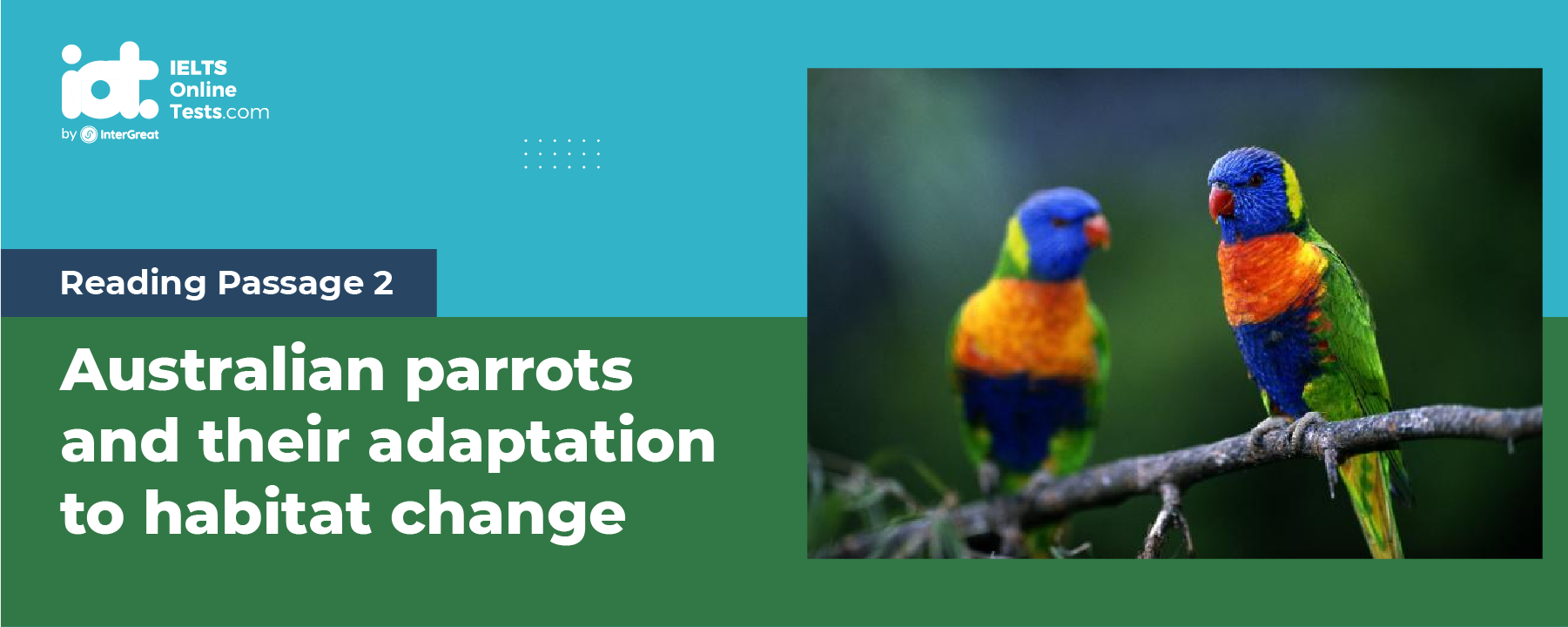
F Differently shaped beaks are not the only adaptations that have been made during the developing relationship between parrots and their food plants. Like all of Australia's many honey eating birds, the rainbow-coloured lorikeets and the flowers on which they feed have long coevolved with features such as the shape and colour of the flowers adapted to the bird's particular needs, and physical a example, red is the most I attractive colour to birds, and thus flowers which depend on birds for pollination are more often red, and lorikeets' to gues have bristles which help them to collect as much pollen as possible.
G Today, most of Australia's parrots inhabit woodland and open forest, and their numbers decline towards both deserts and wetter areas. The majority are nomadic to some degree, moving around to take advantage of feeding and breeding places. Two of the dry country parrots, the pink and grey galah and the pink, white and yellow corella have expanded their ranges in recent years. They are among the species that have adapted well to the changes brought about by European settlement forest telling created grasslands where galahs and corellas thrive.
H But other parrot species did not fare so well when their environments were altered. The clearing of large areas of rainforest is probably responsible for the disappearance of the double-eyed fig parrot, and numbers of ground parrots declined when a great part of their habitat was destroyed by the draining of coastal swamps. Even some parrot species that benefited from forest clearing at first are now comforted by a shortage of nesting sites due to further man-made changes.
I New conditions also sometimes favour an incoming species over one that originally inhabited the area. For example, after farmers cleared large areas of forest on Kangaroo Island off the coast of South Australia, the island was colonised by galahs. They were soon going down holes and destroying black cockatoo eggs in order to take the hole for their own use. Their success precipitated a partial collapse in the black cockatoo population when the later lost the struggle for scarce nesting hollows.
J There may be no final answer to ensuring an equitable balance between parrot species. Nest box programmers help ease the shortage of nesting sites in some places, but there are not enough, they are expensive and they are not an adequate substitute by large, old trees, such as the habitat they represent and nectar, pollen and seeds they provide. Competition between parrots for nest sites is a result of the changes we humans have made to the Earth. We are the most widespread and dangerous competitors that parrots have ever had to face, but we also have the knowledge and skill to maintain the wonderfully rich diversity of Australia's parrots. All we need is the wild to do so.
Part 1
Questions 1-5
Choose the correct letter, A, B, C or D.
Write the correct letter in boxes 1-5 on your answer sheet.
Questions 6-10
Do the following statements agree with the claims of the writer in Reading Passage ?
In boxes 6-10 on your answer sheet, write
| YES. | if the statement agrees with the views of the writer | |
| NO. | if the statement contradicts the views of the writer | |
| NOT GIVEN. | if it is impossible to say what the writer thinks about this |
6. The diamond campaign worked by making a connection in people's minds between diamonds and luxury
7. People are more aware of visual marketing than auditory marketing.
8. The campaign advertising diamonds had a positive influence on society.
9. There is still some uncertainty about whether animals copy the behaviour of the most powerful animals among them.
10. Consumers make a logical connection between celebrities ' achievements and the products they promote.
Questions 11-14
Complete each sentence with the correct ending , A-G , below
Write the correct letter, A-G , in boxes 11-14 on your answer sheet.
11. The behaviour of the monkeys on the island of Koshima showed that
12. Primatologist Frans de Waal found that
13. Dick Fosbury is mentioned in order to show that
14. A feature of some modern marketing campaigns is that
| A. | people imitated behaviour that was linked with success . | |
| B. | younger animals of a certain species are more likely to imitate each other. | |
| C. | an animal would imitate another that had higher status . | |
| D. | imitation of popular sportspeople has occurred for many decades . | |
| E. | products are marketed to potential consumers who are unaware that marketing is occurring . | |
| F. | animals can develop new habits by observation. | |
| G. | incentives are provided for consumers who behave in a certain way. |
Part 2
Questions 15-20
Reading Passage has ten paragraphs A-J
Which paragraph contains the following information?
Write the correct letter, A-J in boxes 15-20 on your answer sheet
An example of how one parrot species may survive at the expense of another 15.
A description of how plants may adapt to attract birds 16.
Example of two parrot species which benefited from changes to the environment 17.
How the varied Australian landscape resulted in a great variety of parrot species 18.
A reason why most parrot species are native to the southern hemisphere 19.
An example of a parrot species which did not survive changes to its habitat 20.
Questions 21-23
Choose the correct letter A, B, C, or D
Write the correct letter in boxes 21-23 on your answer sheet
Questions 24-27
Complete the summary below
Choose NO MORE THAN TWO WORDS AND/OR A NUMBER from the passage for each answer.
Write your answers in boxes 24-27 on your answer sheet
There are 345 varieties of parrot in existence and, of these, 24 live in Australia. As early as the 25 , the mapmaker 26 recognized that parrots lived in that part of the world. 27 , the famous painter of animals and birds, commented on the size and beauty of the Australian parrot family.